
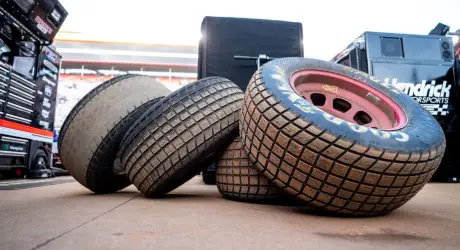
People have always loved competition. Since the invention of cars, car wars or racing tournaments took place on one of the most prominent competitive platforms like NASCAR, where people have invested a lot of time, energy, and money.
This competition has also given some unexpected advantages to ordinary drivers. Some tire companies like Goodyear, the official tire supplier for NASCAR, have evolved the passenger tires by integrating all the new technology and data used in racing tournaments. For example, Goodyear designed Eagle High-Performance Tires for passenger cars.
Specs of NASCAR Tires
NASCAR is the best stage for tires to prove their mettle because Goodyear and other teams keep a keen eye on their cars and tires. What’s more, it is considered the best test for tire manufacturers because racing on different tracks and conditions puts maximum stress on the tire.
The tires used in NASCAR have fixed specifications, and every team has to follow them. For example, the wheel diameter should be 15 inches, and the width should be no more than 10 inches. The Goodyear Eagle Race Tires have smooth tread and are also called slick, while the size is 28/10-15. Their weight is 24 pounds, and the tread thickness is only 0.125 inches.
NASCAR Tires and Driving Conditions
The standard tires have different tread patterns that help in removing water from the tire surface. But NASCAR tires are all slick, which means they have no tread pattern, and their texture is almost bald. The reason for doing this is to provide maximum contact with the road at high speeds. For this reason, NASCAR races are delayed when it’s raining.
The focus of NASCAR tires is to produce various slick tires for different tracks by inspecting all the racecourses and their conditions like the building materials, road banks, dryness of road surface, wear, and age of tracks.
This research helps NASCAR to specify the right tire for each of the 23 sanctioned tracks.
How are NASCAR races handled?
These racing cars run at such high speeds that drivers experience gravitational force and impact equivalent to the astronauts during rocket launches. This colossal force puts great strain on the right-side tires when the cars consecutively turn left using banks. Every time the vehicle turns left, the right tire has to bear a force of 4,000 pounds, which is four times that the left tire has to face.
To solve this problem, a practice called staggering is observed in which the tires on the right are inflated to 45 psi while left ones to 30 psi and the right tire are also 1 inch larger. In addition to this, Goodyear also uses the reinforced sidewalls.
What is the cost of a NASCAR tire?
A set of Eagle tires costs $800, which means the price of a single tire is $200. Every racing team is allocated with an equal number of tires ranging from 5 to 14 sets determined by the race length. It means that $22,000 worth of tires is used for a single race.
Eagle Race Tires has a mileage of around 150 miles, showing the harsh conditions the tires face during races. But all these experiments have made driving even safer for ordinary drivers.

Reviewed by Alex Ross
Content Editor, responsible for maintaining the quality and accuracy of the information presented on our blog.
Same articles
Mobile Auto Repair and Maintenance Services: Convenient Car Care Wherever You Are
GuidesWhen a vehicle breaks down or starts showing signs of trouble, getting it to a traditional repair shop is not always easy. Mobile auto repair services solve this problem by bringing professional...
The Hidden Math Behind Zoom Whitening Profit in Houston Practices
GuidesOn paper, teeth whitening should be one of the most profitable services a Houston dental practice offers. The chair time is short, demand is steady across the metro's...
Why Professional Appliance Repair Is Essential for a Comfortable Home
GuidesModern homes depend on appliances every single day. A washing machine keeps laundry under control, a refrigerator protects food, a dryer saves time, and an oven makes daily cooking easier. When...